
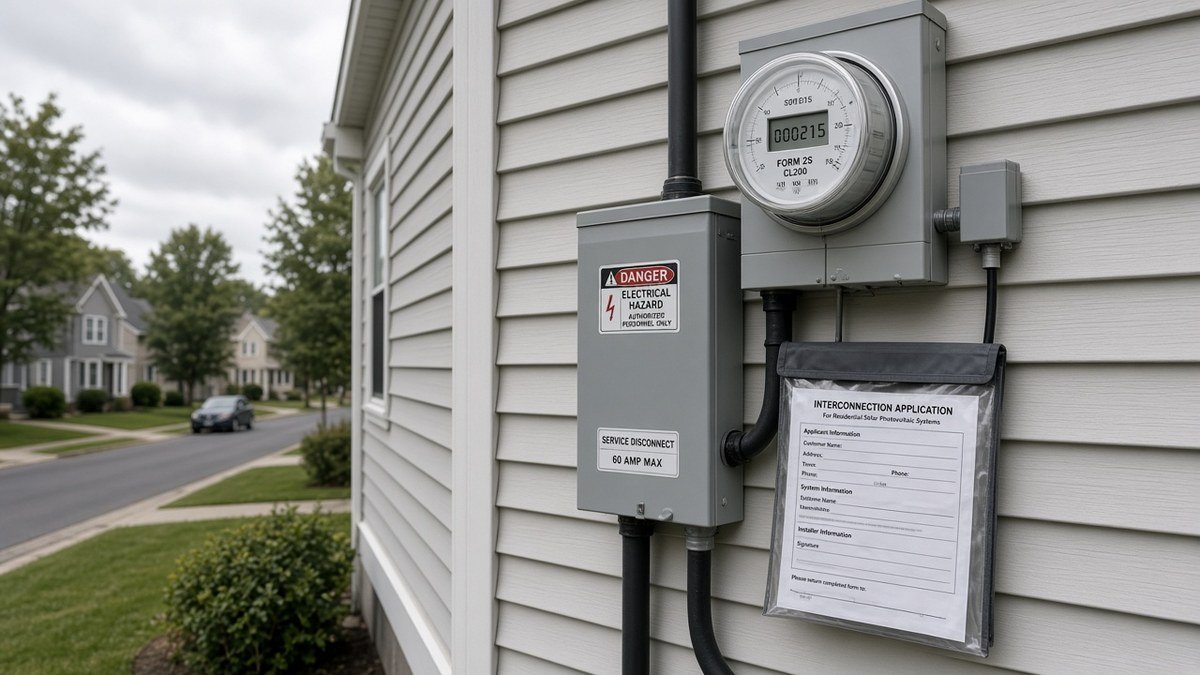
Eversource Connecticut interconnection packages bounce when PowerClerk, the RRES election, and the one-line describe different kW, meters, or customers. Installers treat RRES as “the solar program” and forget it rides on PURA interconnection guidelines. Eversource reviews both at once. If the drawings show a 27 kW AC inverter on a single-family roof, you are not on the residential tariff path no matter what the sales proposal promised.
This is the Eversource CT residential packet, not a UI comparison essay. For the two-EDC overview see Athol’s Eversource versus UI post. For incentive rules see the RRES installer guide. For drawings plus forms, stay here.
Eversource Connecticut interconnection files that must match RRES
System installers or authorized agents apply on behalf of the system owner and customer of record. The customer still has to review and sign what PowerClerk generates. Do not initial for them. Incomplete signatures are a completeness fail, not a “we’ll wet-sign at PTO” trick.
RRES (Residential Renewable Energy Solutions) launched January 2022 under Conn. Gen. Stat. § 16-244z and replaced legacy net metering plus RSIP for new enrollments. PURA’s program page notes 2026 updates to Buy-All and Netting rates, application fees, and a working group on customer disclosure forms (Docket context on the PURA RRES page). Eversource’s RRES program manual version 2026.1 is listed effective January 1, 2026. The Application Date is the date Eversource determines the installer provided a complete tariff and interconnection application in the portal, with required fields, documents, and fees. That date sets the applicable incentive rate. A pretty one-line that sits in email while PowerClerk is unpaid is not an Application Date.
Size and site: live Eversource consumer-facing RRES pages have required a current or future Eversource customer, 1-4 family property, Home Energy Solutions assessment unless the home was built in 1980 or later, and a system at or under 25 kW that is also sized to historical load. Confirm each bullet on the live RRES page before you tell a customer they are eligible. [CONFIRM AS OF 2026-09-19] If they fail HES or load sizing, that is a program problem. It still shows up as an incomplete or ineligible PowerClerk file.
Choose Buy-All or Netting in the application and draw that metering. Eversource publishes metering guidelines, metering diagrams, a temporary approved non-bypass socket list for RRES netting production-meter use, and a netting meter configuration template. Those diagrams are design guidance. They are not construction drawings you can submit instead of a project-specific one-line. If Netting needs a production meter, show it. If Buy-All uses a different sequence, show that. A generic “PV to main panel” sketch is how metering comments start.
Guidelines and fees Eversource has posted
Eversource’s Connecticut Application to Connect page states that guidelines and fees are filed and approved by PURA. The table on that page has listed:
- Residential inverter-based generators 50 kW or less: $200 application fee, with a guidelines PDF
- Fast Track: residential inverters greater than 50 kW; C&I less than or equal to 2 MW: $500
- Study process: complex projects greater than 2 MW: $1,000
A separate guidelines PDF is also listed for residential inverter-based generators 25 kW or less. RRES itself caps residential tariff projects at 25 kW AC. Fast Track is where oversized residential and most C&I live. Do not file a 25 kW RRES application for a 40 kW roof and hope the $200 invoice covers it.
The Renewable Energy Solutions interconnection page has listed a $200 distributed generation application fee and a $163 Renewable Energy Solutions application fee. Pay what PowerClerk invoices. Completeness waits on payment. PURA FAQ language used by the EDCs has said conditional approval can arrive in 2-5 weeks from submission and fee payment, whichever is later, with final PTO depending on construction and municipal inspection. Treat those as utility-stated goals, not a contract. [CONFIRM AS OF 2026-09-19]
Drawings and cut sheets PowerClerk will open
One-line: existing service voltage and amperage, main breaker, bus rating, interconnection method, inverter make/model/listing (UL 1741 SB is what NRES webinars have been reminding C&I crews; residential should not show an obsolete listing if the SKU is SB), AC disconnect, meters, and storage if any. Conductor and conduit notes belong here if the municipal set has them. Eversource should not see a different breaker than Hartford or Manchester will inspect.
Site plan: array location, meter, disconnect, and enough of the building that a field inspector can find the equipment. If the meter is indoors today, Eversource and UI C&I guidance has been pushing outdoor, grouped meters. Residential RRES may still hit a “move the meter” comment. If you already know the meter is in a closet, say so on the site plan and budget the relocation instead of being surprised in week three.
Cut sheets: modules, inverters, and storage. The SKU in PowerClerk must be the SKU on the drawing. Contractor compliance for RRES (program manual Section IX, plus EOE guidance in Docket 25-08-02RE01 for 2026 filings) is a company-level obligation. It does not replace a correct cut sheet on this job.
Disclosure and contracts: RRES requires customer-facing program forms based on the customer’s selections. Generate them from the portal. Do not attach a 2024 PDF with 2025 rates. PURA called out 2026 rate and fee updates on the program page. Eversource consumer pages have published a 2026 Buy-All rate of $0.3289/kWh for approved applications submitting in 2026, and they have described 2026 Netting REC payment and a $0.0402/kWh on-bill Solar Energy Adjustment for netting applicants in 2026. Quote those only from the live page the day you sell. [CONFIRM AS OF 2026-09-19]
Municipal permit and PTO are still other desks
Connecticut municipalities still want a building permit (and often a separate electrical permit) using the Standardized Solar PV Permit Application Supplement. Eversource will not accept a town sticker as interconnection completeness. Run AHJ and PowerClerk in parallel. Connecticut design keeps the supplement, one-line, and site plan consistent.
Zero-export does not skip interconnection. PURA RRES FAQs have said even self-consumption-only systems must go through the interconnection process. Do not invent a behind-the-meter exemption.
After install: municipal inspection, required meter work, and Eversource’s written permission to operate. Athol’s PTO explainer is the language page. Rate 980 exists as an alternative to RRES on Eversource’s site and is not billed like the old net metering program. If a customer is on Rate 980, the one-line and the portal election have to say so. Do not draw RRES netting meters on a Rate 980 job.
Comments we answer: AC kW over 25 on an RRES file, HES not scheduled on a pre-1980 house, one-line missing the production meter for the elected netting configuration, customer name mismatch, unpaid $163 fee, inverter SKU swap, and a Fast Track roof filed on the residential form. Fix the field they named.
PowerClerk hygiene that protects the RRES Application Date
The Application Date is when Eversource calls the combined tariff and interconnection file complete, including fees. If you submit a one-line on Monday and pay on Thursday, do not tell the customer they locked 2026 Buy-All rates on Monday. Incomplete signatures, an unpaid $163 invoice, or a missing HES flag on a 1950s house will slide that date. In a year when rates change, that slide is money.
Load history: RRES wants the system sized to historical load. If the portal asks for kWh and you type a sales estimate, you will answer a comment later. Pull the bill PDF or the Eversource usage download. If the house is new and has no history, use the program’s new-construction path, not a fictional 12-month chart. [CONFIRM AS OF 2026-09-19]
HES: pre-1980 homes that skip the assessment sit incomplete. Put the HES status on the kickoff form. If the assessment is scheduled after install, ask Eversource whether that is allowed before you promise a truck. Do not hide the build year.
Metering diagrams: print the Eversource netting or Buy-All figure that matches the election and hold it next to your one-line. If the figure shows a production meter and you omitted it, stop. If the figure shows a socket type that is not on the approved list, stop and read the temporary approved non-bypass socket spreadsheet. A random square on the wall labeled “meter” is not a configuration.
When Eversource comments, answer in PowerClerk, not in a side email to a friend at the company. Attach the revised one-line with clouds. If the comment is kW over 25, you are on Fast Track and possibly NRES, not on a rounded residential tale. If the comment is unpaid fee, pay it. If the comment is customer name, fix identity before you redraw rails.
Municipal parallel: Manchester, Hartford, and a dozen other Eversource towns all want the CT supplement. The supplement bus rating must match PowerClerk. A 200 A story in the portal and a 100 A panel in the basement is a failed inspection and a PTO hold together.
Send the bill, load history if you have it, equipment list, Buy-All versus Netting choice, and the AHJ name. Athol’s interconnection desk will tell you whether this is an Eversource Connecticut interconnection residential PowerClerk file or a Fast Track packet before anyone types 25.01 kW into a tariff application.