
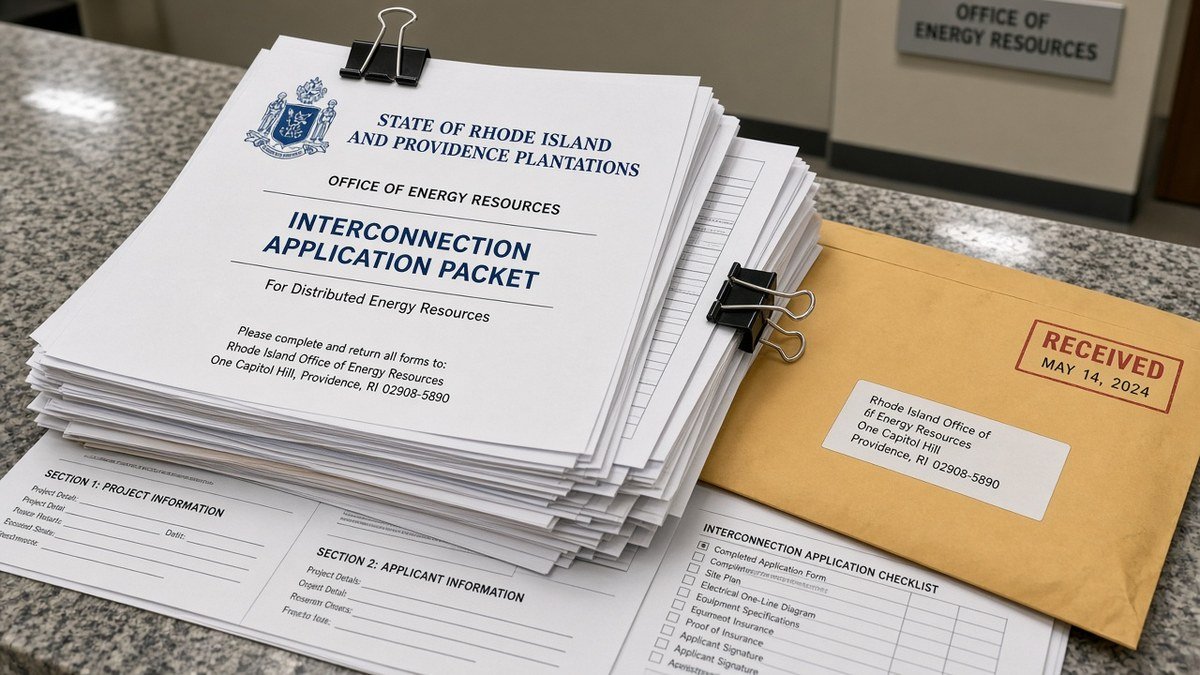
A Rhode Island interconnection application sits incomplete when you upload a roof photo, an unsigned Exhibit A, and a cut sheet for last year’s inverter. Customer Energy Integration (CEI) screens a tariff packet. RIPUC 2258 (effective September 1, 2022) tells you which exhibit you are on. The portal does not forgive a missing legal information document because the city already issued a building permit.
Use this as a working checklist. Confirm live portal labels and fee text before you quote a customer. Athol Energy builds the interconnection stack from the same one-line as the permit design set so CEI and the AHJ are not grading two arrays.
Rhode Island interconnection application checklist by track
Before any exhibit: confirm electric service exists at the proposed PCC. If you need a new service, a three-phase upgrade, or a relocated meter, open that work request first. Rhode Island Energy’s Simplified process article puts that step ahead of preparing the IA. Filing Exhibit A against an account that cannot take the service you drew is how you get an application number and then a stop.
Identify the track with nameplate and topology, not with optimism. Simplified is listed inverter-based facilities able to export 25 kW or less, on a transformer configuration that matches facility phase, on radial EDS, passing the tariff screens. Jobs that would have been Simplified on a spot or area network are sent to Expedited under current tariff practice. If you are over 25 kW or non-inverter, you are not on Exhibit A.
Simplified stack
From Rhode Island Energy’s Simplified process article, budget at least:
- One-line diagram (required for Re-Growth and net metering)
- Site diagram (same)
- Technical specifications: cut sheets and technical references for all equipment, PDF only
- Exhibit A, Simplified Interconnection Application (pick the net metering version or the Re-Growth version, not a mashup)
- Legal information document
- Exhibit I retail customer agreement if applicable
- Schedule B if the job is net metering
Read the Simplified terms in Exhibit A before the customer initials them. Submit through the portal. CEI contacts the people listed on the IA and the legal information document and issues an application number. Completeness is later, when those initial documents are received and approved.
Expedited stack
From the Expedited process article, budget:
- Exhibit C, Expedited/Standard Interconnection Application, initialed and signed
- Legal information document
- Schedule B for Re-Growth or net metering as applicable
- Recent copy of the electric bill
- IA fee payable to Rhode Island Energy. Published figure we have: $3/kW, maximum $2,500, minimum $300. Confirm live. [CONFIRM AS OF 2026-09-19]
- Design diagrams, including a PE-stamped diagram. Three-line if they ask
- Copy of any pre-application report if you pulled one (Exhibit B pre-application form exists on the documents page)
The Expedited article says that once the IA fee check and signed IA form are received, CEI communicates status. Completeness still waits on the rest of the initial documents being approved. Do not tell a C&I customer they are “in study” because you paid the fee. They are in intake until CEI says the application (not the project) is complete.
Standard / study stack
If you fail Expedited screens you will see supplemental review, feasibility, impact, or detailed study agreements. The documents page lists Exhibit D through H and Exhibit I, the Interconnection Service Agreement, all under RIPUC 2258 effective September 1, 2022. Those are legal clocks with deposits. Put them on the project manager’s calendar. They are not a PE’s redline of a one-line, though the one-line will still have to match whatever the study assumed.
Diagrams CEI can screen without guessing
One-line: IEEE-style symbols, inverter make/model/listing, kW AC and DC, existing service size and voltage, main breaker, interconnection method, isolation device, PCC, production or bi-directional meter as the program requires, rapid shutdown as installed, and storage if contracted. ESB 756 wants PCC and POC called out, ratings, and a revision block. For larger DG it also wants an electrical PE stamp at application, at later acceptance reviews, and at as-built. If you are on a 200 kW Expedited roof, budget that stamp. If you are on an 8 kW Simplified ranch, do not copy the 200 kW title block and then forget to stamp it.
Site diagram: building outline, array location, meter, disconnect, and access. Pole numbers for overhead PCC if that is the service. For underground commercial, ESB 756 talks about pad-mount space. Residential Simplified still needs a diagram a meter tech can use. A satellite image with a red box is not a site diagram.
Cut sheets: the SKUs on the drawings. Include modules, inverters, racking if CEI asked, isolation device, and storage. PDF only on Simplified. If purchasing swapped inverters after you uploaded, upload the new PDF and cloud the one-line. A completeness approval on revision 0 does not survive a silent SKU change.
File naming on larger jobs should follow ESB 756’s habit: case number, document type, revision, date. Even on Simplified, “finalfinalv3.pdf” is how the wrong one-line gets screened.
After completeness: do not mix in completion docs early
Certificate of Completion, Exhibit A2 or B2, witness-test packages, and commissioning memos are completion documents. Rhode Island Energy updated Expedited and Standard completion checklists in June 2026 on the documents page we reviewed. Simplified completion checklists have been listed with an October 2023 update. Do not upload Exhibit A2 with the original IA. CEI is not ready for it, and you will bury the files they need for completeness.
Witness-test procedure templates exist for jobs that need them. If the ISA says witness test, put it on the schedule. Testing is not Authorization to Interconnect. The PTO closeout post covers meters and the authorization letter. This checklist stops at a complete IA and a clean handoff into construction.
Pre-application (Exhibit B) is optional on many small roofs and useful on constrained feeders or C&I sites. If you received a pre-application report, attach it to Expedited so CEI does not rediscover a known constraint in week four.
Common incompleteness items we answer: unsigned Exhibit A, legal information document missing, Schedule B blank on a net-metering election, one-line AC kW disagreeing with Exhibit A, site diagram missing the disconnect, cut sheets for a different inverter, bill attached to the wrong account, Expedited fee not received, and Simplified filed on a 30 kW AC inverter. Answer the deficiency list. Do not resubmit the original ZIP as “please see attached.”
Run the municipal permit in parallel using the statewide solar permit. Rhode Island design keeps those sheets aligned. For a three-state process overview see Athol’s MA, RI, and CT interconnection guide. The Rhode Island interconnection application you file this week is still RIPUC 2258 plus the live portal, not a Massachusetts simplified form with the header changed.
How we assemble a CEI folder without mixing completion into intake
Create a folder with two subfolders on day one: IA and CLOSEOUT. Nothing from CLOSEOUT goes to the portal until CEI asks for completion. Exhibit A2 in the IA upload is how a Certificate of Completion lands in a completeness queue and nobody can find the one-line.
IA folder contents we actually use: bill PDF, Exhibit A or C (correct track), legal information document, Schedule B or REG enrollment set, one-line PDF, site diagram PDF, cut sheets merged as one PDF in SKU order, PE-stamped diagram if Expedited, fee receipt if Expedited, pre-application report if it exists. Name files with address, document type, and date. “Scan” is not a name.
Before upload, a human reads Exhibit A kW against the one-line AC box against the inverter cut sheet rating. Those three numbers are the Simplified versus Expedited decision. A 25.6 kW AC inverter is not Simplified. Rounding it to 25 in a sales note does not change UL nameplate.
Network versus radial: if you do not know, say you do not know and attach a photo of the service. Spot and area networks are how Simplified jobs get recoded to Expedited. Guessing radial on a downtown Providence secondary network wastes the first CEI cycle.
When CEI lists deficiencies, reply in their order. Deficiency 1: missing legal document, attach legal document. Deficiency 2: one-line kW, cloud the kW. Do not send a new full ZIP that also changes the module because purchasing had a sale. One subject per resubmittal unless they asked for a complete replacement package.
Keep the municipal permit moving in the other subfolder. Completeness at CEI does not inspect rails. DIS does not countersign Exhibit A. Parallel clocks. The Rhode Island interconnection application is only the utility clock, and it is enough work without mixing in HDC minutes.
Witness-test jobs (Expedited/Standard with ISA language) get a third subfolder: TEST. Procedure template, commissioning memo if required, photo log. That folder stays closed until construction. Opening it during intake is how someone uploads a blank witness-test template as if it were a one-line.
Send the bill, the equipment list, AC kW, program (net metering or REG), and whether the service is radial or network if you know it. We will return a track call (Simplified versus Exhibit C) and a file list before anyone drafts a title block.