
A solar interconnection application is the packet you send the electric utility so it can review your PV system against its tariff and then, later, issue written permission to operate. It is not the building permit. It is not SMART, NY-Sun, or RRES paperwork. Mix those up and the job sits in a queue while the roof is already finished.
This guide is for installers and EPCs working Massachusetts, Rhode Island, Connecticut, New York, and Pennsylvania. The vocabulary changes by utility. The sequence does not: complete application, technical review, construction under conditional approval, inspection, meter work, then a permission to operate letter (PTO). Some crews still search PPO or permit to operate. Those are the same closeout step. Until that letter or portal notice exists, do not export.
What a solar interconnection application actually is
The utility is asking whether the inverter, nameplate rating, and point of interconnection will behave on its feeder. National Grid Massachusetts publishes the rules in its Standards for Interconnection of Distributed Generation (the current M.D.P.U. tariff on the company’s DG pages). Rhode Island Energy uses its Standards for Connecting Distributed Generation. Connecticut follows PURA interconnection guidelines that Eversource and United Illuminating both apply through separate PowerClerk portals. New York uses the Public Service Commission’s Standardized Interconnection Requirements (SIR) for systems 5 MW or less. Pennsylvania EDCs follow 52 Pa. Code Chapter 75.
Your solar interconnection application is complete only when the utility says it is complete. A PDF dump is not the same thing. Missing one-lines, unsigned terms, or a service address that does not match the billing account will bounce the file. National Grid’s Massachusetts process notes that an incomplete package is placed on hold and the completeness clock restarts once you fix it. Rhode Island Energy’s Customer Energy Integration (CEI) group does the same: they will not treat the interconnection application as complete until the required exhibits and diagrams clear their checklist.
Application, AHJ permit, and PTO are three clocks
Town building and electrical permits come from the Authority Having Jurisdiction. The interconnection application goes to the EDC. Permission to operate, PPO, or whatever phrase the portal uses is the utility’s written OK to energize for export.
We still see crews treat the inspector’s sticker as PTO. It is not. Rhode Island Energy states that interconnecting customers are not permitted to operate generation before an official Authorization to Interconnect, and that they can be held liable for damage from unauthorized operation. PECO’s interconnection brochure says the same in plainer language: begin operating only after a signed Permission to Operate letter and, where needed, new meters.
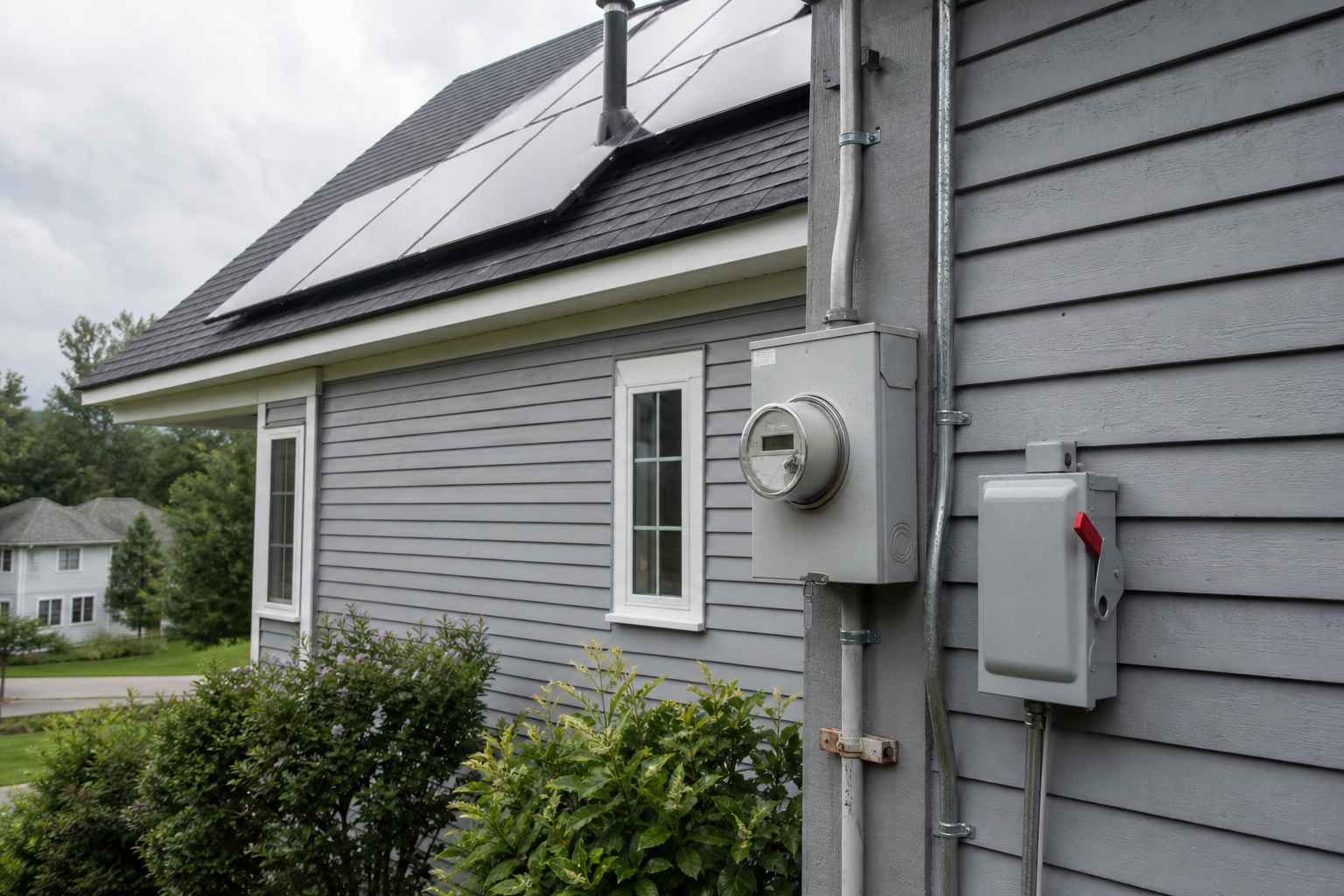
Moving forward after inspection means uploading the completion package, waiting for the bidirectional meter if net metering applies, and reading the PTO email before anyone closes the AC disconnect in the ON position for production.
What usually belongs in the packet
Utilities do not share one form, but the solar interconnection application almost always wants:
- Site and account data that match the electric bill
- Nameplate kW AC, module DC, and inverter models with UL 1741 listing
- A one-line (sometimes a three-line) showing the point of interconnection, disconnect, and meter
- Cut sheets, not marketing brochures
- Application fee for the process track you actually qualify for
- Signed terms, Exhibit A, or the portal equivalent
- For larger jobs, a pre-application report
National Grid Massachusetts requires a site-specific Pre-Application Report for DG or storage with aggregate nameplate of 250 kW or greater. Smaller systems may request one. New York’s SIR charges $750 for a pre-application on projects above 50 kW in the large-DG track; Con Edison notes there is no application fee for systems 50 kW or less in the small-DG PowerClerk portal. Connecticut Eversource lists published application fees on its Application to Connect page: $200 for residential inverter-based generators in the smaller track, $500 Fast Track, $1,000 Study Process. Confirm the current table before you quote a customer. Tariffs move.
Simplified, expedited, Fast Track, SIR, Level 1
Do not force a 200 kW commercial roof onto a residential simplified form. National Grid’s Massachusetts DG pages describe Simplified as listed inverter-based systems at or below 15 kW single-phase or 25 kW three-phase on radial circuits that pass the screens (read the live tariff; M.D.P.U. numbers change). Rhode Island Energy’s Simplified path is listed inverter-based facilities 25 kW or less on radial systems that pass Figure 1 screens. Connecticut splits 25 kW-or-less inverter guidelines from Fast Track and Study. New York splits at 50 kW AC. Pennsylvania Level 1 is certified inverter-based facilities 10 kW or less under 52 Pa. Code section 75.34.
If you pick the wrong track, the interconnection application comes back. That is not a “soft delay.” Queue position and study fees sit on the correct track.
How to keep the application from stalling
Match the one-line to the permit set. If the AHJ package shows a 7.6 kW inverter and the portal says 10 kW because sales changed the equipment, the utility will stop you. PE stamps on the electrical drawing help when the EDC asks who is responsible for the design, but a PE stamp is not a substitute for a complete application.
Upload as-built or field-change drawings when the installed array is not what was approved. Several utilities will not issue PTO until the completion documents match the field. That is where as-built drawings earn their keep.
If CEI, National Grid, or PowerClerk asks for a revision, answer that item. Do not resubmit the whole binder with a new filename and hope they notice page 14. Moving the interconnection application forward is mostly boring: one missing cut sheet, one mismatched account number, one unsigned terms page.
PTO, PPO, and permit to operate
Permission to operate is the industry phrase. Permit to operate and PPO show up in search and in some installer Slack threads. Treat them as the same closeout: written utility authorization after a complete interconnection application, construction, inspection, and meter work. SMART enrollment in Massachusetts, NY-Sun in New York, and RRES in Connecticut pay or credit generation. They do not replace PTO.
Athol Energy prepares interconnection packages that line up with permit design and PE stamping so the one-line in the portal is the one-line in the town packet. If you are starting a Northeast job, send the utility territory, nameplate, and target submit date.
Sources: National Grid Massachusetts DG process, Rhode Island Energy interconnection process, Eversource Connecticut Application to Connect, Con Edison applying for interconnection, 52 Pa. Code Chapter 75.