
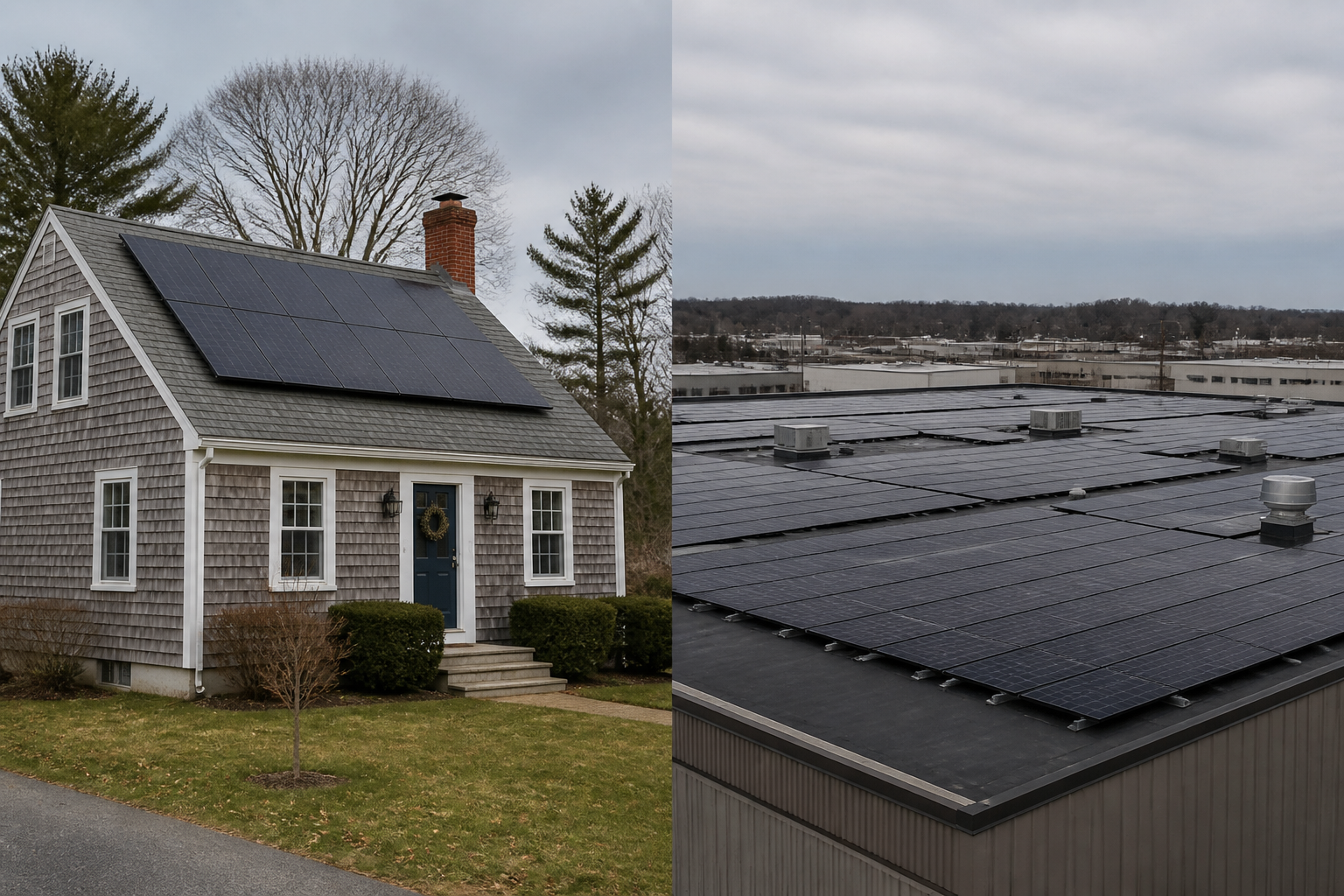
Solar permit differences between residential and commercial jobs are not a vibe. They show up as extra sheets, extra stamps, extra reviews, and a longer overlap with the utility interconnection application. A 8 kW roof in Worcester and a 400 kW roof on a big-box store in the same utility territory do not use the same packet.
This is what actually changes for Northeast installers (Massachusetts, Rhode Island, Connecticut, New York, Pennsylvania). Local AHJs still win arguments. Confirm the town’s current checklist.
What stays the same
Both need a site plan, an electrical diagram, equipment cut sheets, and a path through NEC 690/705 (rapid shutdown, labeling, interconnection disconnect). Both need a building and/or electrical permit from the AHJ. Both need a utility interconnection application if they will export. Both need written PTO before production. Residential vs commercial does not erase those.
What a residential solar permit usually is
Most residential solar permits in the Northeast are rooftop, service-voltage, Simplified / Level 1 / small-DG interconnection on the utility side. The AHJ wants:
- Array layout, fire access pathways, setbacks
- Attachment details and snow/wind notes that match the climate
- Electrical one-line or three-line
- Cut sheets
- Sometimes a structural letter or PE stamp, especially on older two-family stock, tile roofs, or when the town’s checklist says so
Boston ISD, Providence, Hartford, NYC DOB, and Philadelphia each have their own intake. “Residential” is not a free pass in NYC or in a historic district.
Interconnection for these jobs is often National Grid MA Simplified, Rhode Island Energy Simplified (≤25 kW listed inverter), Eversource/UI small inverter guidelines, NY SIR ≤50 kW, or PA Chapter 75 Level 1 if you are actually ≤10 kW. A 12 kW Pennsylvania home is already past Level 1. Size, not marketing language, picks the track.
What a commercial solar permit adds
Commercial solar permits layer on:
- Architectural or zoning review more often (use, rooftop occupancy, screening)
- Fire department comments on access, labels, and sometimes firefighter plans
- Structural PE as a default, not a maybe, on many large rooftops
- Electrical PE on many AHJs and almost always when the service is complicated
- Medium-voltage or line-side tap details
- Ground-mount zoning, stormwater, and environmental notes if you leave the roof
- A utility interconnection application on Expedited/Standard, Fast Track/Study, SIR large-DG, or Chapter 75 Level 2/3
The one-line gets longer. The title block needs a professional engineer in responsible charge where state law and the AHJ require it. A NABCEP certification in the corner is not that stamp.
Sales proposals for commercial jobs also change: demand charges, tariff class, and interconnection study risk belong in the sales proposal before you promise a date.
Timelines: two clocks, not one
How long does commercial solar permitting take? The honest answer is: the AHJ clock and the utility clock, in parallel, and the utility often finishes last.
A residential solar permit in a town with online residential PV intake can be days to a few weeks if the set is complete. Commercial plan review is scheduled, sometimes in cycles, and comments come in batches. Meanwhile a 500 kW Massachusetts Standard interconnection or a New York CESIR is not a Simplified email. Eversource Connecticut publishes Study Process times on the order of 105 to 120 business days for >2 MW. That is interconnection, not the building permit, but it dominates the commercial calendar.
Do not quote “eight weeks, turnkey” unless you have both the AHJ and the EDC in writing.
Where installers mix the two packets
Copying a residential title block onto a commercial set is how you collect a reject. Missing fire access on a warehouse roof is another. Filing a Simplified interconnection application on a 80 kW commercial service is a third.
Residential vs commercial solar permits also differ in who signs. Homeowner vs landlord vs corporate officer vs licensed electrician. Get the applicant right or the permit sits.
How we split the work
Athol Energy’s permit design sets are built to the AHJ. PE stamping is for the sheets that need a licensed PE in the project state. Interconnection is the utility packet, which grows faster than the building permit as kW grows. Residential production: Residence Solar. Larger sites: Commercial and Utility.
If you are deciding whether a job is “just residential paperwork,” look at nameplate, occupancy, and interconnection track, not the sales deck cover.
Sources: Eversource CT Application to Connect (for how commercial/study tracks diverge from small inverter guidelines), NY SIR, 52 Pa. Code Chapter 75, National Grid MA process.