
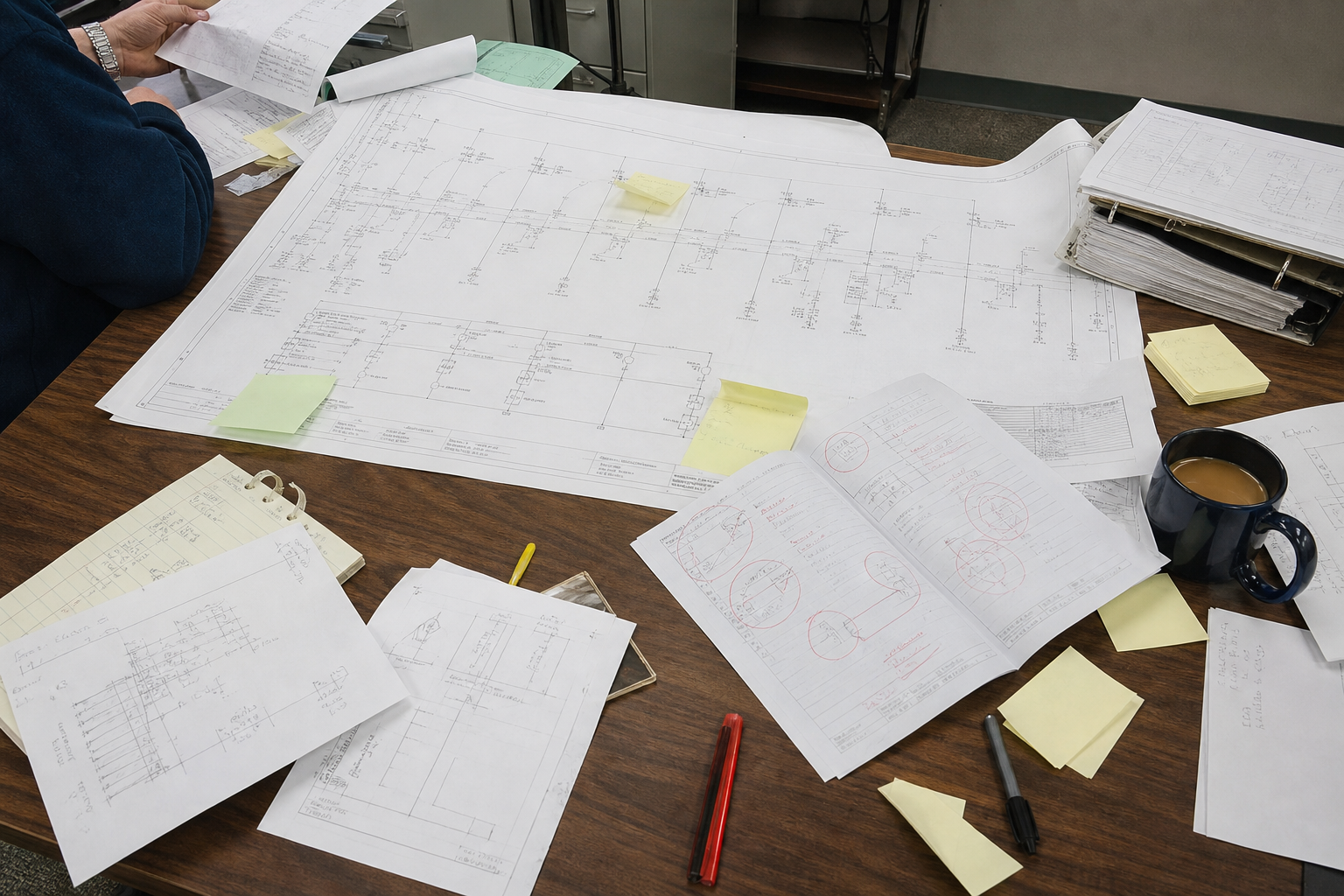
An incomplete interconnection application is not a polite delay. It is a stopped clock. National Grid Massachusetts puts Simplified cases on hold and emails the issues. Rhode Island Energy will not call the file complete until CEI has every required exhibit. Pennsylvania’s Chapter 75 Level 1 procedure even writes a 10-business-day completeness window into section 75.37. Until completeness is granted, you are not in screening, not in queue in any useful sense, and not moving forward.
This post is about why packages bounce and how to get the solar interconnection application running again.
Completeness is a defined event
Utilities are not being fussy for sport. The tariff tells them they cannot start technical review on a partial file. If they did, every installer would submit a name and a kW guess, then trickle cut sheets for a month while holding a queue slot.
Rhode Island Energy’s Simplified process in the interconnection tariff: acknowledge within 3 business days, then notify within 10 business days whether the application is complete, and if not, what documents, fees, or materials are missing. That list is your punch list. It is not a suggestion.
National Grid’s Simplified application article describes the same pattern in portal language: issues place the case on hold; a clean package moves to Screening-Submitted, then screening has its own business-day clock.
New York’s SIR tells the utility to notify if the application is incomplete after receipt (and fee, on the large-DG track). Fixing the file is how you keep a queue position. Filing a brand-new interconnection application because you were embarrassed is how you lose it.
What incomplete usually means on East Coast jobs
We do not see mysterious engineering mysteries at this stage. We see:
- Service address that is the mailing address, not the service address
- Account number from an old tenant
- One-line missing the AC disconnect or showing the wrong utility voltage
- Inverter model on the form that is not the cut sheet attached
- DC kW in the AC nameplate field
- Unsigned terms / Exhibit A
- Application fee for Simplified when the job is Expedited, or no fee when Fast Track requires one
- Pre-application skipped at National Grid MA ≥250 kW
- Connecticut one-line without the isolation device called out relative to the meter (Eversource wants that relationship drawn)
- Pennsylvania Level 1 used on a 15 kW inverter (Level 1 is 10 kW or less, certified equipment, under section 75.34)
Each of those is fixable. None of them fix themselves if you call the utility twice a week without uploading the missing page.
Do not restart the queue unless you have to
If CEI or National Grid lists three deficiencies, upload those three. Do not create a second portal case “to be safe.” Two cases for one service address confuse completeness and can strand the original queue position.
If the equipment truly changed (sales swapped to a different inverter family), say so. A revision on an existing interconnection application is cleaner than a ghost duplicate. For SIR and larger MA/RI tracks, a material modification after an ISA can reopen study. Ask before you assume a SKU swap is “admin.”
Moving forward after a hold
Treat the hold email as a spec:
1. Quote the utility’s item numbers in your reply or portal note. 2. Replace the one-line if the drawing was the problem. Do not upload v3 and v4 with no indication which is current. Put a revision cloud and a date in the title block. 3. Match the permit design set. If the town packet still shows the old inverter, you will fail inspection even if interconnection clears. 4. If they asked for a PE stamp on the electrical drawing, get a PE-stamped sheet from an engineer licensed in that state. A NABCEP logo in the title block is not a PE seal. (NABCEP is a personnel certification. It does not sign drawings.) 5. Resubmit once, complete.
Then leave it. Completeness clocks restart from a clean package. Pestering during the tariff window does not shorten it.
After completeness, the next stall is closeout
Some jobs sail through screens and then die on completion documents. Rhode Island Energy will not issue Authorization to Interconnect, and will not consider you free to operate, until completion docs and (for net metering) the bi-directional meter are done. That is still the interconnection application’s life cycle. PTO / PPO / permit to operate is the last page of the same story, not a new department.
If the field changed, file as-built drawings rather than hoping the meter tech does not notice extra modules.
A completeness pass before you click submit
Athol Energy reviews interconnection packets against the utility’s current exhibit list for Massachusetts, Rhode Island, Connecticut, New York, and Pennsylvania. The goal is boring: first-pass complete, then screening, then a PTO that matches the nameplate you installed.
If a job is already on hold, send the deficiency email and the current one-line. Moving forward is usually a document, not a meeting.
Sources: 52 Pa. Code section 75.37, National Grid submitting MA Simplified, RI Energy interconnection process, RI Energy Standards for Connecting DG, NY SIR.